
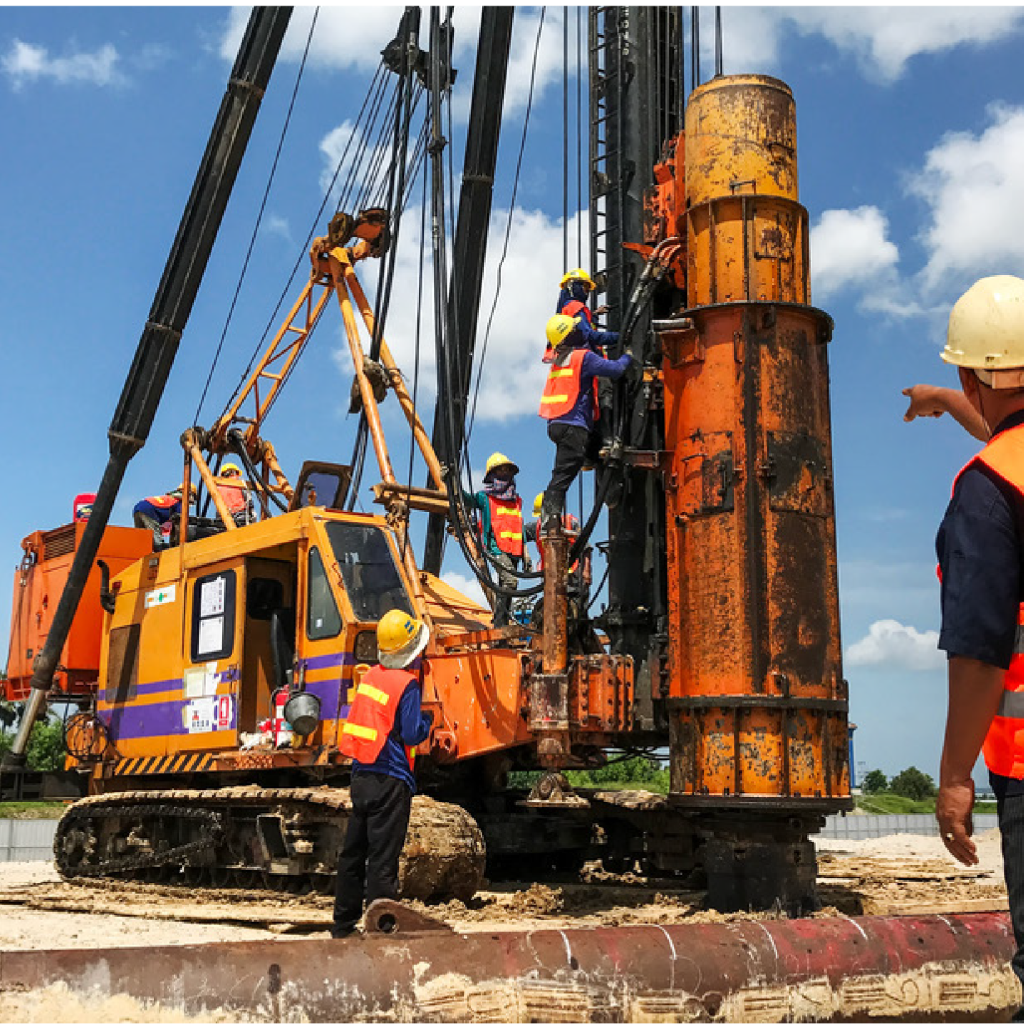
Ground engineering is HEIBCO's core specialism
HEIBCO describes itself as a contractor specialising in ground engineering, and deep foundations are where that specialism concentrates: piling, groundwater control and the environmental management that goes with them on civil infrastructure projects. When a structure cannot be founded safely on shallow footings — because the competent stratum is deep, the loads are heavy, the water table is high, or an excavation must be supported next to an existing building — the deep foundation package determines the programme and much of the risk on the whole job.
Techniques HEIBCO executes
- Bored piles — rotary bored piles under bentonite or polymer support fluid, and continuous flight auger (CFA) piling where ground and access suit it.
- Secant and contiguous pile walls — interlocking or closely spaced pile walls forming a retaining structure for basements and deep excavations, secant walls where water tightness is required.
- Diaphragm walls — reinforced concrete panels installed under slurry, used for deep basements and permanent retaining structures carrying vertical load.
- Sheet piling — driven or vibrated steel sheet piles for temporary support and waterfront work.
- Micropiles — small-diameter piles for underpinning, restricted-access sites and strengthening existing foundations.
- Ground improvement — treatment of weak or loose soils to raise bearing capacity and limit settlement.
- Groundwater control — wellpoint and deepwell dewatering systems keeping excavations workable and stable.
Why deep foundations are so common in Egypt
The Nile Delta and Greater Cairo are built largely on alluvial deposits — layers of silt, clay and sand of variable competence — frequently with groundwater within a few metres of the surface. Coastal work in Alexandria adds saline groundwater and its durability implications for concrete. Under those conditions, mid-rise and high-rise structures, basements of more than one level, and heavily loaded industrial slabs commonly need piled support even where a neighbouring low-rise building sits happily on pads. The practical consequence is that the geotechnical investigation, not the architectural drawing, should set the foundation strategy.
How the work is sequenced
A deep foundation package normally runs: geotechnical investigation and interpretation, foundation design or design review, piling platform preparation, setting out and installation, then testing. Testing is the part clients most often underestimate — pile integrity testing on a broad sample, cross-hole sonic logging on larger-diameter piles where cast quality must be proven, dynamic testing, and static load testing on selected working or preliminary piles. HEIBCO builds those hold points into the programme so approvals do not stall the superstructure.
Working next to existing structures
Urban sites in Cairo rarely offer clear working room. Where an excavation abuts an occupied building, the retaining system is chosen for stiffness and water tightness as much as cost, and movement is monitored during excavation rather than assessed afterwards. Vibration-sensitive neighbours generally rule out driven piling in favour of bored techniques. These decisions are cheapest to make at tender stage, which is why HEIBCO prefers to be involved while the foundation concept is still open.
Frequently asked questions
What piling methods does HEIBCO use?
Rotary bored piles and continuous flight auger (CFA) piles, secant and contiguous pile walls, diaphragm walls, sheet piling, micropiles, ground improvement and dewatering systems for groundwater control.
How do I know whether my project needs deep foundations?
The geotechnical investigation decides it. Where competent bearing strata lie deep, loads are heavy, the water table is high or a deep basement is planned — all common in Cairo and the Delta — shallow footings are usually not viable. Have the soil investigation done before the foundation concept is fixed.
Can piling be carried out next to existing buildings?
Yes. Bored techniques are normally used instead of driven piling on vibration-sensitive sites, with a retaining system chosen for stiffness and water tightness and ground movement monitored during excavation.
What pile testing does HEIBCO carry out?
Pile integrity testing, cross-hole sonic logging on larger-diameter piles, dynamic testing, and static load testing on preliminary or selected working piles, as the specification requires.
Discussing piling or deep foundations on a live project?
Send drawings, a bill of quantities or an outline scope to [email protected] or call +20 2 2537 5569. HEIBCO's estimating team is based at the New Cairo head office and works Sunday to Thursday, 09:00–17:00 (EET). You can also use the contact form.
Related HEIBCO services
Civil construction · MEP engineering · Roads & infrastructure · Water & wastewater treatment · Fit-out & finishing