
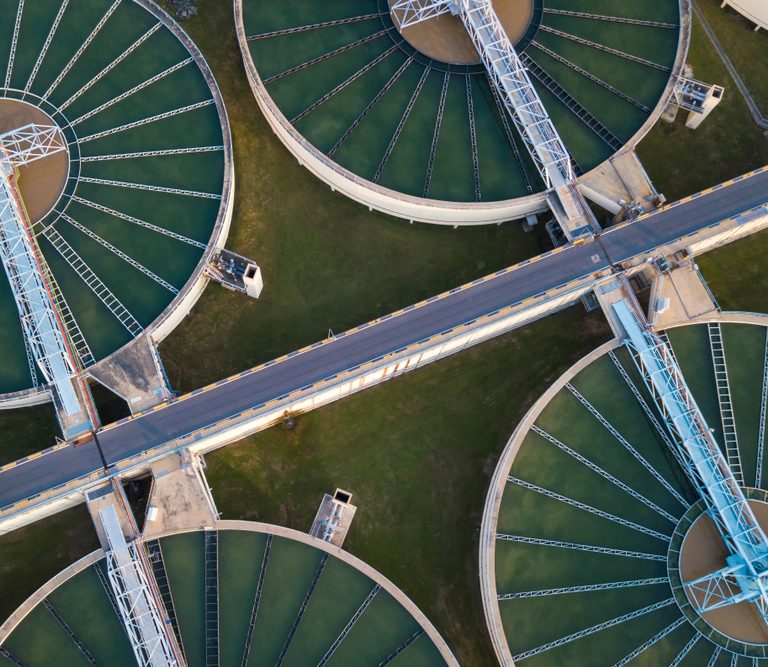
Water and wastewater treatment plants
Water infrastructure is among the more technically demanding categories of construction, because the finished asset is judged on process performance rather than appearance: a plant either meets its discharge or potable standard consistently, or it does not. HEIBCO builds water and wastewater treatment facilities and the networks that feed them, drawing on the same ground engineering and groundwater control capability that deep, water-retaining structures require.
Facilities and scope
- Wastewater treatment plants (WWTP / STP) — municipal and private sewage treatment works, including package plants for compounds, resorts and industrial facilities.
- Potable water treatment — treatment works and associated storage.
- Pumping stations — sewage and water pumping stations, including deep wet wells requiring shoring and dewatering during construction.
- Reservoirs and tanks — reinforced concrete water-retaining structures built and tested for water tightness.
- Networks — the collection and distribution mains linking the plant to the development, delivered with the infrastructure works.
Treatment processes
The right process depends on the load, the effluent standard and how much land is available. Conventional activated sludge remains the workhorse for larger municipal flows. Sequencing batch reactors (SBR) suit variable loads and compact sites. Moving bed biofilm reactors (MBBR) offer robustness to load swings, and membrane bioreactors (MBR) produce a high-quality effluent suitable for reuse in irrigation where footprint is tight and standards are strict — an increasingly common requirement on Egyptian resort and compound developments where treated effluent irrigates landscaping.
What determines whether a plant works
Three things, mostly. Water tightness of the concrete structures, proven by testing before backfill rather than discovered in service. Correct installation and commissioning of the mechanical and electrical plant — blowers, pumps, screens, dosing systems and the control philosophy that runs them, which overlaps directly with HEIBCO's MEP capability. And a genuine process commissioning period, because a biological plant needs its biomass established and its performance demonstrated against the specified standard before handover means anything. Building the structure is the straightforward part; proving the process is the part that needs planning.
Construction constraints
Treatment structures are deep, heavily reinforced and water-retaining, which puts them squarely in the territory of excavation support and dewatering. On high water table sites — most of the Delta — flotation of empty tanks during construction is a real risk that has to be designed against, not managed by hoping. HEIBCO's groundwater control experience is directly applicable here, and is one reason the company treats water infrastructure as an extension of its ground engineering work rather than a separate discipline.
Frequently asked questions
What treatment processes does HEIBCO build?
Conventional activated sludge, sequencing batch reactors (SBR), moving bed biofilm reactors (MBBR) and membrane bioreactors (MBR). Selection depends on the load, the required effluent standard and the land available.
Does HEIBCO build package plants for compounds and resorts?
Yes — package sewage treatment plants for compounds, resorts and industrial facilities, as well as larger municipal works, pumping stations, reservoirs and the associated networks.
Can treated effluent be reused for irrigation?
Where the effluent standard and the process allow it, yes. MBR in particular produces a quality suitable for landscape irrigation, which is a common requirement on Egyptian compound and resort developments.
What is the main construction risk on a treatment plant?
Water-retaining structures are deep and usually built in high groundwater. Excavation support, dewatering and designing against flotation of empty tanks during construction are the critical items, alongside proving water tightness by test before backfill.
Discussing a treatment plant on a live project?
Send drawings, a bill of quantities or an outline scope to [email protected] or call +20 2 2537 5569. HEIBCO's estimating team is based at the New Cairo head office and works Sunday to Thursday, 09:00–17:00 (EET). You can also use the contact form.
Related HEIBCO services
Civil construction · Piling & deep foundations · MEP engineering · Roads & infrastructure · Fit-out & finishing